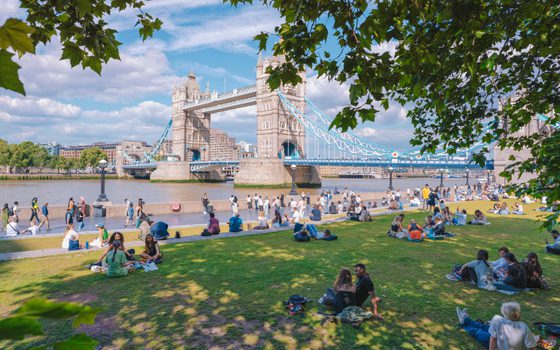
South-west England loses title as Brits’ number one UK holiday hotspot
London now takes the top spot, driven by short city breaks and overnight stays before flying abroad
25 May 2026


Despite its reputation as the seaside holiday capital of the UK, south-west England is no longer Brits’ favourite UK holiday hotspot, according to analysis from the New Economics Foundation (NEF) published today. The analysis finds that the UK’s traditional seaside, countryside and small-town destinations are losing out to the rise of short city breaks and holidays abroad.
Despite London being only the fifth most popular staycation destination a decade ago, the capital climbed to the top spot last year. NEF analysis suggests that this is down to the popularity of short city breaks as well as UK tourists staying a night in London before flying to holiday destinations overseas.
Outside London, every UK region has seen a reduction in domestic tourism over the past decade, with the south-west suffering the most, followed by Yorkshire and the Humber, Wales and Scotland.
Trips | |||
Rank | 2015 | 2025 | 2015 – 2025 change in market share |
1 | South-west | London | 61% |
2 | South-east | North-west | 23% |
3 | North-west | South-east | -7% |
4 | Scotland | South-west | -36% |
5 | Wales | Scotland | 2% |
6 | Yorkshire and the Humber | Wales | -8% |
7 | London | East of England | 14% |
8 | East Midlands | West Midlands | 20% |
9 | East of England | East Midlands | 6% |
10 | West Midlands | Yorkshire and the Humber | -21% |
11 | North-east | North-east | 3% |
Dr Alex Chapman, head of economic and environmental policy at the New Economics Foundation (NEF), said:
“The trends revealed today are worrying but also entirely predictable. The aviation industry enjoys a sweetheart deal of tax reliefs and government-backed airport expansion, encouraging people to holiday solely overseas. Rail travel that would enable us to explore our own country is extortionately expensive. Meanwhile our domestic holiday destinations are faced with soaring costs. Only a transformative policy package can bring back the Great British Holiday.”
The coastal areas losing out from changing holiday patterns are also some of the UK’s most deprived communities, now hit by tourism jobs and tourist money moving elsewhere. NEF recommends that the government boost the UK’s seaside, countryside and small-town tourist destinations by cutting bus and rail fares, improving east-west rail connectivity, reforming business rates, increasing capital investment in high streets and communities, cutting energy bills for small businesses, and increasing investment in culture and the arts.
Contact
James Rush /james.rush@neweconomics.org
Notes
The New Economics Foundation is a charitable think tank. We are independent of political parties and committed to being transparent about how we are funded.
The analysis will be available at https://neweconomics.org/2026/05/the-south-west-has-lost-its-crown-as-britains-favourite-holiday-destination from 00.01 Monday 25 May 2026.
This analysis uses data from the Great Britain Tourism Survey (GBTS) provided by VisitBritain. The analysis focuses on trips and spending reported in the Q3 (July-September) period, described here as ‘summer’. Data gathered from GBTS surveys prior to 2020 was gathered from VisitBritain, VisitWales, and VisitScotland respectively. These older datasets are provided separately in PDF format. While the GBTS underwent a methodology change during the Covid pandemic we understand that relative comparisons between groups (in this case regions) remain robust.
Topics Transport Local economies