Nationwide solar panel scheme could lower electricity bills for 8m households with no upfront cost
Cooperation between government and Bank of England could save households £250 a year
07 July 2026


8m households in the UK could see their electricity bills instantly drop through a nationwide scheme which would enable the mass-installation of home solar power and batteries with no upfront cost to households, according to new research from the New Economics Foundation (NEF) and Finance Innovation Lab (FIL), published today.
If the government worked with the Bank of England to create a nationwide scheme to rollout out home solar power, backed by low-interest loans at 2%, the average eligible household could save £250 a year, even while paying back their loan. The analysis calls for the Bank of England to create a secondary interest rate, with the specific aim of cutting inflation through low-carbon energy.
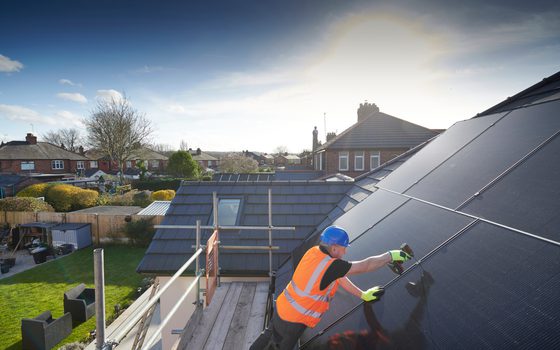
Rooftop solar and battery systems are easy to install and lower electricity bills. Any excess power not being used in the home can be stored in a battery or sold back to the energy grid at peak times when prices are high. But currently, the high upfront costs put them out of reach for many homes which would benefit – in particular the poorest households who struggle to afford their energy bills.
Dubbed the “Solar Saver” scheme, the proposal would see the Bank of England provide cheaper loans to enable banks and building societies to lend money at a low interest rate of 2% to households looking to install solar panels and batteries in their homes, with no upfront cost. In previous years, the Bank has used mechanisms to reduce borrowing rates below the headline interest rate, including after the Brexit referendum and during the Covid-19 lockdowns.
Jesse Griffiths, chief executive of Finance Innovation Lab, said:
“For too many households, solar panels are a good idea they simply can’t afford. Our research shows that, with the right finance model, millions of homes could install solar panels and batteries with no upfront cost, cut their energy bills from day one, and strengthen Britain’s energy security — with no direct cost to the government.”
Dr Alex Chapman, head of economic and environmental policy at the New Economics Foundation, said:
“Green technologies have come on leaps and bounds and have huge potential to save households money from day one and over their lifetime. But so far we haven’t done anywhere near enough to remove the obstacle presented by the high upfront cost they come with, which prices out those on low incomes. Our next prime minister needs to work hard and fast to protect families from fossil fuel volatility while we transition to cheap homegrown energy.”
Notes
The New Economics Foundation is a charitable think tank. We are independent of political parties and committed to being transparent about how we are funded.
Finance Innovation Lab is a UK-based charity working to transform the financial system to deliver better outcomes for people, the economy and the environment.
The model estimates the impact of cheaper financing costs for rooftop solar and battery installation. It allows us to factor in multiple variables, including house type (based on roof orientation, geography and likely solar yield) and the size of solar and battery systems, as well as different interest rates for loans, to produce an estimate for the average annual savings that each household could expect to make on their energy bills. We find that, if loans could be offered at a 2% interest rate or lower, the typical household could expect to save more than £250 per year, whilst simultaneously paying off the initial loan. Once that loan has been repaid, after an average of 15 years, the total annual savings would increase to more than £800 per year.
Topics Climate change Environment