Budget missed opportunity to bring down inflation
More ambitious cost of living measures could have quadrupled the impact of government inflation reduction
28 October 2026


The chancellor has missed an opportunity to bring down inflation rates, according to analysis from the New Economics Foundation (NEF). The research suggests a more ambitious package of cost-of-living policies would take inflation from the OBR’s projected 3.64% to 2.88% by June 2027.
The government’s changes to fuel duty and the removal of VAT from energy bills will reduce consumer price inflation (CPI) from its expected peak in Q2 2027, by 0.22 percentage points. NEF forecasts that a larger cost of living package (including a National Energy Guarantee (NEG), a rent freeze, free bus travel for under-25s and a reduction in the bus fare cap to £1) could have reduced this peak by a further 0.78 percentage points (a full 1 percentage point in total) in Q2 2027.
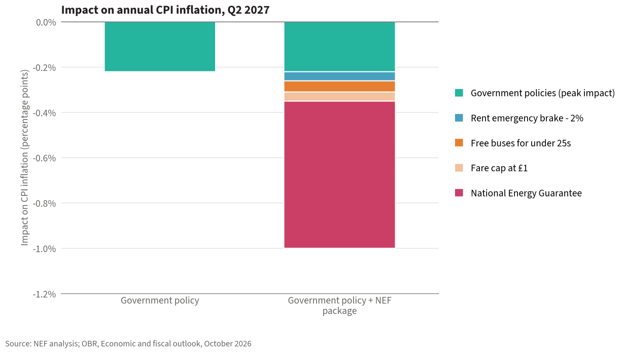
Even without adopting the NEG specifically, NEF argues the design of the government’s energy package announced today is a missed opportunity for an intervention that would both help households and lower inflation. Instead of disbursing funds via local councils, spending the same amount to lower energy bills directly would have reduced CPI further. If this funding were disbursed in Q2 2027 when bills are expected to peak, NEF researchers estimate this could have lowered CPI by an additional 0.97 percentage points (for this quarter only).
A higher inflation rate increases the likelihood that the Bank of England will increase interest rates, which are predicted to start rising from November and into the following year just as energy bills are forecast to rise by 25%.
NEF are warning that increased interest rates will cause more pain for households by driving up mortgage and other borrowing costs, with likely knock-on effects on rental costs. Between 2022 and 2023, interest rate rises pushed 320,000 people into poverty, according to research by the IFS.
Abhijay Sood, senior economist, the New Economics Foundation, said:
“While the cost-of-living measures announced in today’s budget will provide some relief to households, they’ll do very little to bring down inflation. The government’s current reliance on the Bank of England to control inflation with interest rates alone is limited, hurting households and our economy. A bolder package of cost-of-living measures including a National Energy Guarantee, rent controls, and free bus travel for under-25s, would have been good for people’s pockets and good for the economy as a whole.”
Previous budget measures have been responsible for lowering inflation. The removal of levies off energy bills in the 2025 autumn budget was recognised by the OBR as potentially lowering inflation by 0.4 percentage points.
ENDS
Notes
Our estimates are first-order approximations of each policy’s direct effect on the Consumer Price Index (CPI) in Q2 2027, when CPI is expected to peak. For each policy, we calculate the price reduction and multiply it by that item’s weight in the CPI basket, holding ONS weights for February – December 2026 constant.
Q2 2027 was selected both because it is when current energy price cap projections peak, and when government policies are expected to have their strongest impact on inflation. Comparable figures for the whole year are as follows:
Policy and 2027 CPI impact
Impact of government policies announced at budget (upper limit): ‑0.08%
Missed opportunity from £100 discount: ‑0.19%
Rent emergency brake – capping rent hikes at 2%: ‑0.04%
Free buses for under 25s: ‑0.05%
Bus fare cap at £1: ‑0.04%
National Energy Guarantee: ‑0.35%
CPI: 3.42%
CPI with NEF package: 2.94%
Rent cap: we replace the OBR’s forecast for private rent growth with a 2% cap on all private tenancies.
Free buses for under-25s and capping fares at £1: Estimates are based on data from the National Travel Survey. These figures are modelled for the financial year 2027/28, but it is assumed that the fractional saving would be similar for the 2027 calendar year. The baseline scenario – the impact on CPI with the bus fare cap being reduced from £3 to £2 in 2027 – is assumed to be similar to the increase to CPI resulting from the increase in the cap from £2 to £3 in 2025 (disregarding usual fare growth).
National Energy Guarantee: provides a discounted block of energy at the late 2024-unit cost, equivalent to 60% of consumption for the average household, for a 6‑month period, between January and June 2027. Energy bill impacts are based on EDF’s projections of the 2027 energy price cap weighted by seasonal usage. Because the OBR did not have access to the most up-to-date forecast of next year’s energy price cap when making their forecasts, the impact of the National Energy Guarantee may be slightly overestimated here.
These figures capture direct price effects only. We assume little added demand from these policies, as the NEG and bus support would be tax-funded, offsetting the boost to household incomes. Progressive taxation could add slight inflationary pressure by shifting income towards households that spend more of it, although we expect this to be small. Similarly, the rent cap is a transfer from landlords to renters, the latter with a generally higher propensity to spend.