Interest overdue: Why the time is right for a tax on banks
The government are rumored to be raising taxes on banks in the budget - here's why they should go further
26 October 2026


Rumours are rife that taxes will be raised on banks in Burnham’s first budget on Wednesday. This is hardly surprising news: the government is under pressure to raise funds but has ruled out tax increases “on working people”, including income tax, national insurance, and VAT. Meanwhile, banks are posting record profits.
Taxing banks is complicated. Different proposals have different strengths and weaknesses, and interact with other recommendations (eg tiering reserves, for which NEF has long advocated). But when you consider the options available to the government, and massive windfalls enjoyed by banks, the version the government seems poised to pick does not go far enough.
Why it’s fair to tax the banks
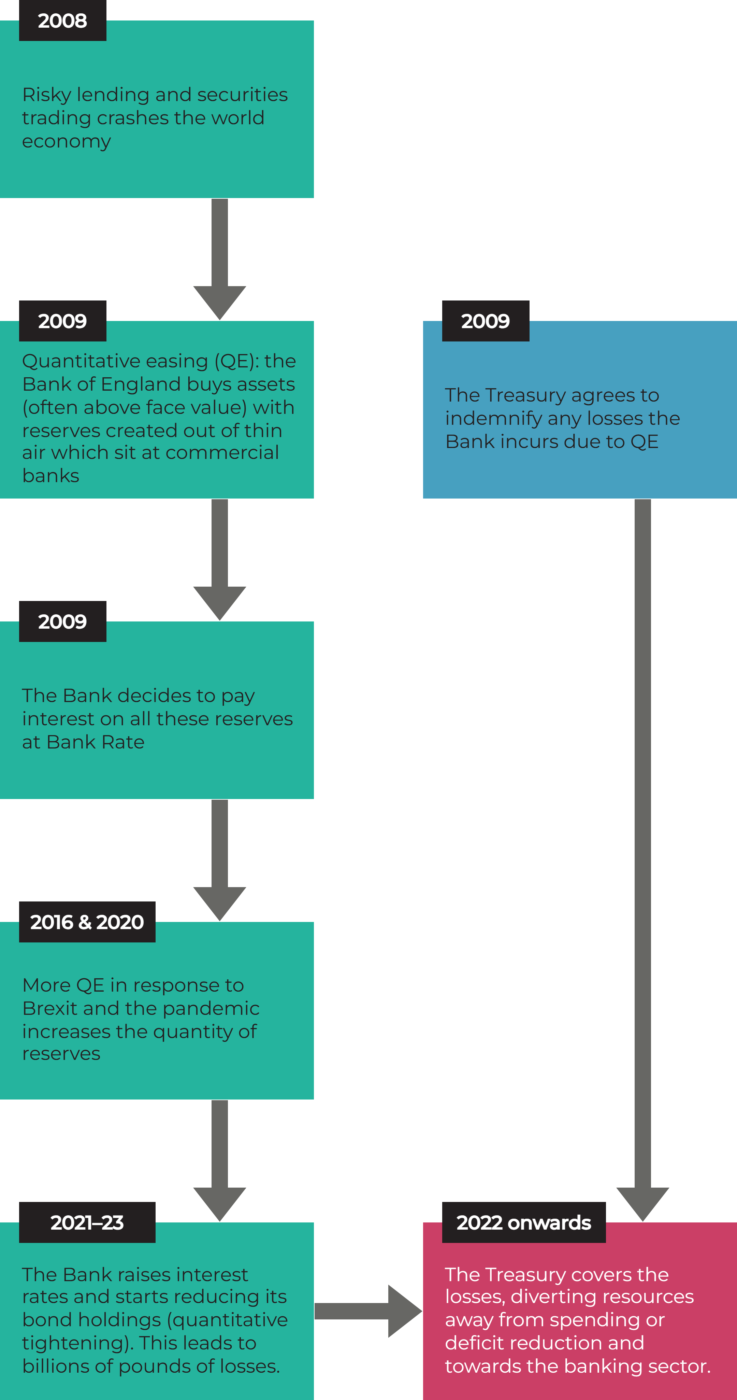
Commercial banks are enjoying a windfall of excess profits for two main reasons. First, they are receiving billions from the public purse as a result of quantitative easing (QE), the decision the Bank of England made to remunerate all reserves, and the fact the Treasury indemnifies the Bank’s losses. This is summarised in Figure 1. The bonds the Bank has bought since 2009 have earned it some interest, but at a low, fixed rate, while the interest it pays out to commercial banks has risen with the Bank rate. The purchased bonds have also fallen in value, in large part for the same reason. The combination of these factors has left the public sector with a massive anticipated lifetime loss: £164bn according to the most recent official figures (although recently announced changes to the quantitative tightening process will likely trim this). NEF has previously described this as a “stealth subsidy” to the banking sector.
Figure 1: A timeline of how decisions by the Bank of England and the Treasury have led to billions being transferred to commercial banks from the public purse.
Second, banks are profiting on the difference between interest rates for lending and saving, particularly by not passing rates on to savers, where people’s unwillingness to “shop around” gives banks more market power. This is always part of banks’ business model, but the gap tends to increase when interest rates are higher.
Together, these create a strong case for taxing banks. As well as raising revenue, a tax could claw back a subsidy they have been receiving from the state, and target the excess profits they make resulting from market power rather than productive activity.
What would higher taxes on banks look like?
Several organisations have published ideas on how to raise bank taxes, including Positive Money, the TUC, and IPPR. Proposals are often influenced by what other countries have attempted, particularly Spain’s windfall tax design. To understand these proposals, we must first understand how banks are currently taxed; this is summarised in Box 1.
Box 1: An explanation of bank taxes in the UK Banks pay corporation tax on their UK profits like any other UK company. After the financial crash, a Bank Levy was introduced, with two (somewhat conflicting) aims: to reduce riskiness in the banking sector, and to raise revenue. It set out to accomplish this by taxing short-term liabilities (12 months or less) on bank balance sheets at a certain rate, and taxing long-term liabilities at half this rate. Over time, revenue raised from this levy fell, partly because it achieved its objective of reducing riskier funding, partly because the rate was cut (after lobbying from the sector), and partly because its scope was restricted to UK balance sheets, due to fears about relocation and international competitiveness. Today, it amounts to a small but significant share of the sector’s tax contribution (often equivalent to 1 – 3% of pre-tax profit for larger banks), varying over time and between institutions. In addition, banks pay a surcharge on corporation tax, introduced in 2016, to ensure that they “make a fair contribution in respect of the potential risks they pose to the UK financial system and wider economy”. The surcharge is essentially an additional amount of corporation tax banking groups pay on profits above £100m (originally £25m) with some minor differences. This was introduced specifically to compensate for losses in revenue from reducing the levy and effectively means that domestically focused banks (for whom UK balance sheets and profits are more important) shoulder a higher burden than large international groups (such as HSBC). Corporation tax has fallen significantly since its 1970s peak, from 52% steadily down to 19%. When the government introduced plans to increase the rate to 25% in 2021, it cut the surcharge from 8% to 3%, justifying this on the grounds of international competitiveness. |
Designing a new tax for banks boils down to a series of simple choices, as follows
- Profit vs. income: Existing taxes mainly target banks’ profits, such as corporation tax and the surcharge. Some new proposals target income instead – in particular net interest income, which encompasses the main sources of excess gains for banks (interest on QE-era reserves and the gap between mortgage and savings rates). Profit taxes are easier to dodge, because profits are easier to massage, but taxing income in this way is less precedented and therefore may result in more resistance from the sector.
- Whether to include fees and commissions: If a tax proposal targets interest income, it may or may not include fees and commissions. Since these can be designed in a way that artificially limits interest income, if a tax does not include them in its base it should include a clear rule that fees or commissions applied in lieu of interest payments are taxed as interest income would be.
- Anti-avoidance rules: The UK bank surcharge incorporates rules which restrict some forms of avoidance (some of which apply similarly to corporation tax generally). The original form of the Spanish windfall tax applied in 2023 and 2024 imposed heavy penalties for passing costs on to customers (eg through higher mortgage rates, lower savings rates, or higher fees), with fines equal to 150% of the passed-on costs.
- Targeted vs. general: Most proposals use the sources of excess profit we describe as part of a general narrative justifying an additional tax. Others, such as IPPR’s proposal, focus on a specific source of excess profit (in their case interest income on QE-era reserves).
- Time horizon: Windfall taxes are usually time-limited, or linked to a specific source of excess profit. Shorter-term taxes can be more politically viable, but also can introduce intertemporal avoidance (ie by shifting profits into later windows). Specific rules can limit this. For example, the Energy Profits Levy – a windfall tax on oil and gas companies – limits the scope for intertemporal loss relief.
- Within or beyond jurisdiction: To avoid fears of relocation or profit migration, some proposals focus only on gains made in the UK, or by entities that would find it harder to leave the UK. There is a trade-off here between competitiveness and fairness if all banks have gained from a windfall, but the least mobile banks are more heavily targeted. This even applies to existing taxes: when the Bank Levy was reduced and the surcharge introduced, smaller UK-focused banks complained that they would shoulder an increased share of the tax burden relative to banks with large overseas operations.
- The level: How high should the tax rate be? This could depend on a revenue target or view of the degree of excess profit banks have been making; fears about compliance, resistance or avoidance; and the downstream impact on credit conditions. Income is higher than profit, so taxes that target it are stronger at the same headline rate (roughly twice as strong based on our internal modelling).
Some of the most prominent proposals for increased taxes on banks, which have been described in previous NEF publications, are summarised in Table 1. This table includes the taxes actually implemented in Spain, as well as proposals which could be adopted in the UK.
Table 1: An overview of proposals for increased taxes on banks
Tax | Profit or income? | Fees and comissions | Rate | When it ends | Retail banks | Investment banking arms | Foreign banks’ local operations |
Spanish windfall tax (original 2023 – 24 design) | Income (net interest income) | Included: added to net interest income | 4.8% of all net interest income, for banks with at least €800m of gross interest and fee income in 2019 | After two years | Yes | Yes | Subsidiaries: yes; branches not named |
Spanish windfall tax (new design 2025 – 26) | Income (net interest income) | Included: added to net interest income | 1% to 7% in bands, on income above €100m | After three years | Yes | Yes | Yes |
Income (net interest income) | Included: added to net interest income | 38% of income above £800m | Not specified | Yes | No | Not specified | |
Profit | Included indirectly, as part of profit | Surcharge raised from 3% to 8%, 16% or 35%, on profit above £100m | Could be time limited and reviewed at the end of the parliament | Yes | Yes | Yes | |
IPPR (inspired by Thatcher-era levy) | Income (interest the Bank of England pays on reserves) | Excluded | All reserve interest income above a 2% rate, on reserves above an allowance (eg 1% of sterling assets), for banks with over £25bn of sterling assets | Automatically, once QE is unwound or Bank Rate falls to 2% | Yes | Yes | Yes |
How much could a tax raise?
1. What is John Healey likely to do?
The rumour mill has been awash with claims over the last week that the government intends to raise taxes on banks, specifically by restoring the surcharge to 8% in line with the most modest of the TUC’s recommendations.
Revenue projections for this proposal to the end of this parliament feature in Table 2. The TUC’s proposal mentions the potential to review this decision at the end of the parliament: if this happened or the surcharge were planned to be temporary, the impact on headroom would likely be lower than in the table, partly because of the shorter time window, but also because of intertemporal avoidance (shifting profits into later years).
Table 2: Revenue projections for restoring the surcharge to 8%
2026/27 (From 1 Jan 2027) | 2027/28 | 2028/29 | 2029/30 | Total | Impact on headroom (stability rule) | |
All banks | £0.4 – 0.5bn | £1.8 – 2.2bn | £1.8 – 2.4bn | £1.8 – 2.5bn | £5.8 – 7.6bn | + £2.0 – 2.8bn |
“Big Four” only | £0.2 – 0.3bn | £1.0 – 1.2bn | £1.0 – 1.3bn | £1.0 – 1.4bn | £3.2 – 4.2bn | + £1.1 – 1.5bn |
Source: NEF analysis. For more detail, see the bottom of this blog.
2. What would we recommend?
Healey’s likely course of action is welcome, but insufficient. It only represents an extra £2bn or so in annual taxes against record-high profits of around a billion pounds a week, much of which is resulting from a direct transfer from the state to the sector. It would take decades for a tax of this nature to reclaim this stealth subsidy, without even considering excess profits from weak pass-through to savers.
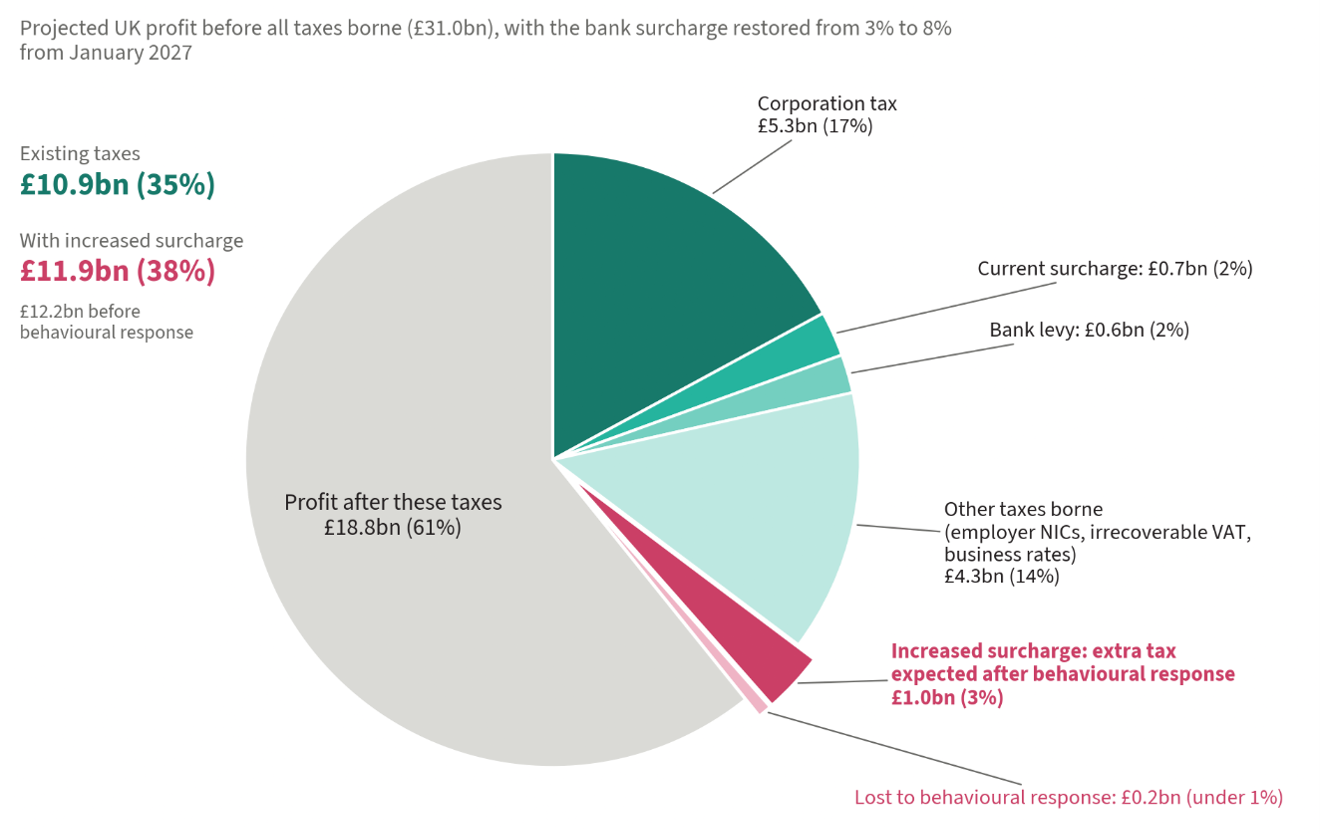
Figure 2 illustrates this, highlighting the relatively small impact that increasing the surcharge to 8% would have as a fraction of the profits of the big four banks in the 2027/28 fiscal year. The projection of bank profits used for this chart is quite conservative; if it is indeed an underestimate, the proportion assigned to other taxes could easily fall, reducing the estimated tax burden.
Figure 2: Where the big four UK banks’ profits would go 2027 – 28
Source: NEF analysis
From a revenue-raising perspective, this modest tax would not have a strong impact on fiscal headroom, nor could it fund much in the way of inflation-busting investment or cost of living support. If this is indeed what is announced on Wednesday, it may seem that the government has made concessions to financial sector lobbying in implementing the smallest possible version of this tax.
The government should go further and deliberately aim to recover the gains from interest on QE-era reserves received by commercial banks. NEF has long advocated for tiering reserves, and we still think that is the best way to minimise QE-linked stealth subsidies in future. However, the government could achieve a similar outcome with a well-designed tax. The fact that transfers from the Bank of England to banks are being underwritten by the government – that these transfers represent an indirect subsidy from the Treasury to commercial banks – means there is a strong case for implementing such a measure.
If the government aimed to recover this money by the end of the planned quantitative tightening schedule in 2034, this would mean raising an order of magnitude more than the modest surcharge increase proposal. This would necessitate a much higher rate, probably achieved in part by targeting income instead of profit as was done in Spain, and as the other proposals describe. It would likely be hindered by both avoidance and legal challenge, although it could be designed in a way that limits the risk and degree of offshoring.
While we should be clear-eyed about the challenges, we should not let them derail the case for bolder bank taxes. Banks received extraordinary support after the financial crisis, via bailouts and QE, while very few bankers suffered any real consequences for the crash their sector caused. They continue to receive a subsidy by stealth that eats away at the government’s ability to pursue other priorities, while ordinary households face a cost of living crisis and the country suffers for a lack of public investment. It is reasonable that banks pay their share to remedy this.
Full methodology note available here.
Image: iStock